
Income Tax is one of the most important sources of revenue for the government. It is a direct tax levied on the income earned by individuals, businesses, and other entities during a financial year. The collected income- tax is used by the government to develop infrastructure, provide public services, fund welfare schemes, improve healthcare, education, and defense, and ensure economic stability.
In India, income tax is governed by the Income- Tax Act, 1961, and administered by the Income Tax Department under the Central Board of Direct Taxes (CBDT). Every eligible taxpayer is legally required to calculate, pay, and file income- tax returns within the prescribed timeline.
What Is Income Tax?
Income tax is a tax charged on the total income earned by a person or entity in a financial year. It is imposed according to predefined tax slabs and rates set by the government.
Key Characteristics of Income Tax
- It is a direct tax, paid directly to the government
- Levied on income earned, not on expenditure
- Calculated annually
- Mandatory for eligible taxpayers
- Governed by statutory laws
Step-by-Step Process for Income Tax Login
Follow these steps carefully to complete the income tax login successfully:
Step 1: Visit the Official Income Tax Portal: Open your web browser and go to the official Income- Tax e-Filing website.
Step 2: Click on the Login Option: On the homepage, locate and click the “Login” button available at the top right corner.
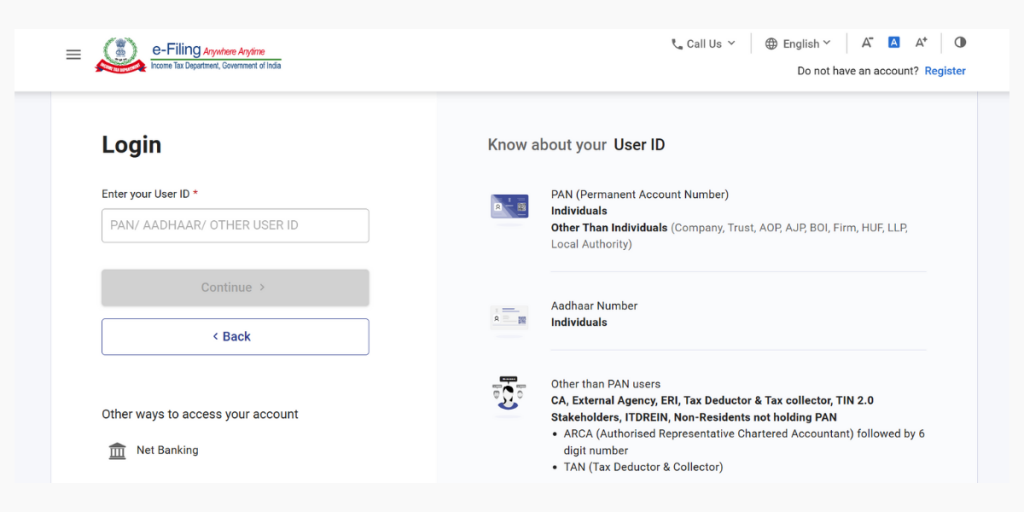
Step 3: Enter User ID: Enter your User ID. PAN, Aadhaar, and Other user id and PAN is mandatory for the income tax login for individuals, firms, and companies.
Step 4: Enter Password: Type your password carefully. Make sure the caps lock is off while entering the password.
Step 5: Verify Captcha Code: Enter the captcha code displayed on the screen to verify that you are a genuine user.
Step 6: Click Login: After entering all required details, click on the Login button to complete the income tax login process.
Prerequisites for Income Tax Login
- Valid PAN (Permanent Account Number)
- PAN linked with Aadhaar
- Registered mobile number and email ID
- Stable internet connection
- Active user account on the Income- Tax portal
Objectives of Income Tax
The primary objectives of income- tax include:
- Generating revenue for government expenditure
- Reducing income inequality
- Promoting economic growth
- Encouraging savings and investments through deductions
- Controlling inflation and consumption
Types of Income Taxpayers
According to the Income Tax Act, any individual whose annual income exceeds ₹4 lakh under the new tax regime or ₹2.5 lakh under the old tax regime is required to pay income tax to the government.
Such individuals and entities are known as taxpayers. Taxpayers in India are classified into various categories based on their identity, structure, and age. The major types of taxpayers are outlined below:
Individuals
This category includes people earning income from salaries, business activities, or other sources. Based on age, individuals are further classified as:
- Individuals below 60 years of age
- Senior citizens between 60 and 80 years old
- Super senior citizens above 80 years
Hindu Undivided Family (HUF)
A Hindu Undivided Family is a family-based taxable entity consisting of members descended from a common ancestor, known as the karta. Income earned jointly by the family is taxed separately under this category.
Association of Persons (AOP)
An Association of Persons refers to a group of individuals who come together for a common purpose to earn income. The group’s revenue is assessed and taxed as a single unit.
Artificial Juridical Person
These are entities that are not natural persons but are recognized by law, such as trusts, societies, and religious institutions or deities.
Firms
This category includes partnership firms and Limited Liability Partnerships (LLPs) that earn income and are taxed as separate legal entities.
Companies
Companies are corporations registered under the Companies Act that generate income and are subject to income tax as per applicable corporate tax rates.
Heads of Income Under Income-Tax
Income tax is calculated based on income earned under five main heads:
| Head of Income | Description |
| Income from Salary | Salary, wages, pension, bonus |
| Income from House Property | Rental income from property |
| Income from Business or Profession | Profits from business or profession |
| Capital Gains | Profit from sale of capital assets |
| Income from Other Sources | Interest, dividends, lottery winnings |
Income Tax Slabs in India
Income tax slabs define the rate at which tax is charged based on income levels.
Income Tax Slabs (Old Regime – Individuals below 60 years)
| Income Range | Tax Rate |
| Up to ₹2,50,000 | Nil |
| ₹2,50,001 – ₹5,00,000 | 5% |
| ₹5,00,001 – ₹10,00,000 | 20% |
| Above ₹10,00,000 | 30% |
Income Tax Slabs (New Regime)
| Income Range | Tax Rate |
| Up to ₹3,00,000 | Nil |
| ₹3,00,001 – ₹6,00,000 | 5% |
| ₹6,00,001 – ₹9,00,000 | 10% |
| ₹9,00,001 – ₹12,00,000 | 15% |
| ₹12,00,001 – ₹15,00,000 | 20% |
| Above ₹15,00,000 | 30% |
Old Tax Regime vs New Tax Regime
| Feature | Old Regime | New Regime |
| Tax Rates | Higher | Lower |
| Deductions | Available | Not Available |
| Exemptions | Allowed | Limited |
| Complexity | High | Simple |
| Suitable For | Tax savers | Salaried with fewer investments |
Income Tax Deductions and Exemptions
Deductions help reduce taxable income under the old tax regime.
Common Deductions Under Section 80C
- Public Provident Fund (PPF)
- Employee Provident Fund (EPF)
- Life Insurance Premium
- ELSS Mutual Funds
- NSC
| Maximum Limit: ₹1.5 lakh |
Other Important Deductions
| Section | Deduction |
| 80D | Health insurance premium |
| 80E | Education loan interest |
| 80G | Donations |
| 80TTA | Savings account interest |
| 24(b) | Home loan interest |
How to Calculate Income Tax
- Calculate gross total income
- Identify income under each head
- Deduct exemptions (if applicable)
- Apply deductions under Chapter VI-A
- Determine taxable income
- Apply tax slab rates
- Add cess and surcharge
Example of Income Tax Calculation
| Particulars | Amount (₹) |
| Gross Income | 8,00,000 |
| Deductions (80C) | 1,50,000 |
| Taxable Income | 6,50,000 |
| Tax Payable | As per slab |
| Health & Education Cess | 4% |
Income Tax Return (ITR)
Income- Tax Return is a form through which taxpayers declare income, deductions, tax paid, and refunds claimed.
| ITR Form | Applicable To |
| ITR-1 | Salaried individuals |
| ITR-2 | Capital gains |
| ITR-3 | Business income |
| ITR-4 | Presumptive income |
| ITR-5 | Firms & LLP |
| ITR-6 | Companies |
| ITR-7 | Trusts |
Process of Filing Income Tax Return Online
- Visit the income- tax e-filing portal
- Register or log in
- Select the applicable ITR form
- Enter income details
- Claim deductions
- Verify tax payable or refund
- Submit return
- Verify using Aadhaar OTP, EVC, or DSC
Due Dates for Income Tax Filing
| Category | Due Date |
| Individual (No Audit) | 31st July |
| Audit Cases | 31st October |
| Revised Return | 31st December |
| Belated Return | 31st December |
Advance Tax
Advance tax refers to paying income-tax in installments during the year if tax liability exceeds ₹10,000.
| Due Date | Percentage |
| 15 June | 15% |
| 15 September | 45% |
| 15 December | 75% |
| 15 March | 100% |
Income Tax Refund
An income-tax refund occurs when excess tax has been paid.
- Excess TDS deducted
- Advance tax overpayment
- Incorrect income estimation
Refunds are credited directly to the bank account.
What Are the Different Types of Income?
In India, every individual is required to pay income-tax on income earned or received, irrespective of their residential status, whether resident or non-resident. To ensure uniform assessment and taxation, the Income Tax Department classifies income into five major heads, each covering specific sources of earnings.
Income from House Property: This category includes income earned from renting out residential or commercial properties. Any rental income received by a property owner is taxable under this head.
Income from Salary: Income earned through employment, such as salaries, wages, pensions, bonuses, and allowances, is taxed under the head of salary income. Tax liability arises from income received from an employer.
Income from Business or Profession: This head applies to income earned by self-employed individuals, freelancers, business owners, contractors, and professionals such as chartered accountants, doctors, lawyers, life insurance agents, and private tutors. Profits derived from these activities are taxable as business or professional income.
Income from Capital Gains: Income generated from the sale or transfer of capital assets, including shares, mutual funds, bonds, or real estate, is taxable under capital gains. These gains are further classified into short-term and long-term capital gains.
Income from Other Sources: Any income that does not fall under the above categories is taxed as income from other sources. This includes interest earned on savings accounts and fixed deposits, dividends, lottery winnings, and other miscellaneous income.
Importance of Income-Tax Filing
- Legal compliance
- Easy loan approvals
- Visa processing
- Proof of income
- Claim refunds
- Avoid penalties
Income-Tax for Salaried Employees
- TDS deducted by the employer
- Form 16 is issued annually
- Can claim deductions while filing ITR
Frequently Asked Questions (FAQs)
What is income-tax and who has to pay it?
Income-tax is a direct tax levied on income earned by individuals and entities. Any person whose income exceeds the basic exemption limit must pay income tax.
What is the difference between old and new income tax regime?
The old regime allows deductions and exemptions, while the new regime offers lower tax rates but minimal deductions.
Is it mandatory to file income-tax return if no tax is payable?
Yes, in certain cases such as high-value transactions, foreign income, or income above exemption limit, filing income tax return is mandatory.
What happens if in come tax return is not filed on time?
Late filing attracts penalties, interest, and may lead to legal consequences.
How can I check my income-tax refund status?
You can check refund status on the income- tax e-filing portal using PAN and assessment year details.